Proof of work
From business problems to working systems.
Each system below was designed and delivered by Smart Girl for a real operating business. They are documented the way they were built — starting with the operational problem, then the system design, then the technology. No invented numbers, no borrowed results: what follows is what the systems do and why they were structured that way.
How each system was reached
The same sequence, every time.
01
Business problem
What is actually going wrong in the operation.
02
System thinking
How the work should move, and who owns each step.
03
Solution
The process, tool or application that supports it.
04
Operational visibility
The record that makes activity measurable.
05
Business value
A business that can be supervised, not just worked in.
Case study 01 · Cleaning Services
Smart Cleaners Partner
- Client
- Business management system for cleaning companies
- Location
- Nigeria
- Our role
- Designed and led delivery
A business management system for cleaning companies — not a booking app. It gives the owner one place to see where enquiries come from, which jobs are running, who is doing them, what has been earned and what customers are saying.
The operational challenge
- Enquiries arrived through social media, WhatsApp and calls, and were only as reliable as the person who happened to see them.
- Bookings, customer details and job history lived in chat threads and notebooks, so nothing could be looked up later.
- Revenue was known roughly, at the end of the month, rather than as the work happened.
- There was no single place to see whether the business was busy, slow, improving or slipping.
What was designed and built
- A public booking page and lead form so enquiries enter one pipeline instead of five inboxes.
- A customer record that carries history, addresses, preferences and past jobs.
- A job lifecycle from booking through assignment, delivery and completion.
- Revenue captured against completed jobs, so income is a by-product of the operation rather than a separate reconciliation exercise.
- Weekly summaries that tell the owner what happened without anyone assembling a report.
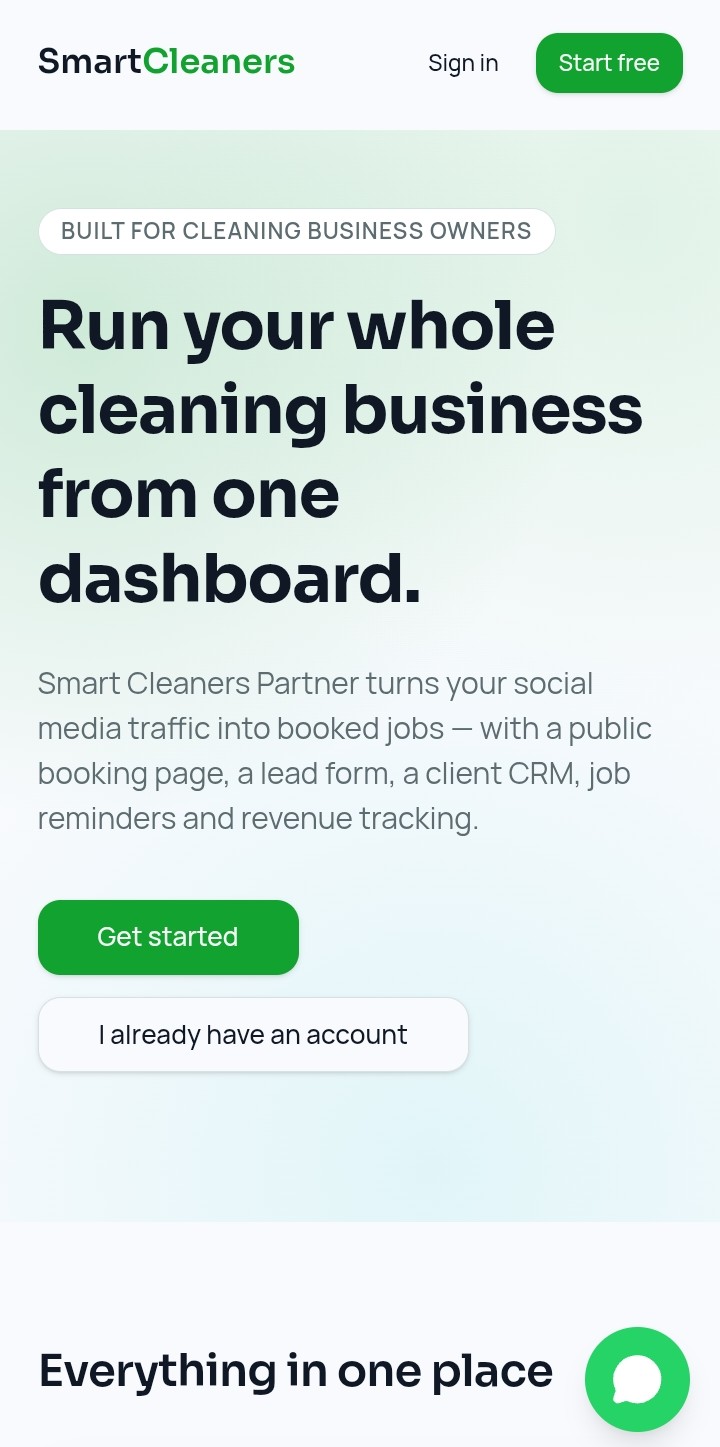
Smart Cleaners Partner — the entry point for cleaning business owners.
Key system components
Lead capture
Public booking page and enquiry form feeding one pipeline.
Customer records
A CRM holding contacts, addresses, history and preferences.
Bookings & jobs
Scheduling, assignment, status and completion tracking.
Revenue tracking
Income recorded against jobs as they are completed.
Staff activity
Who is assigned to what, and what has actually been done.
Reviews
Customer feedback attached to the job it belongs to.
Insights & weekly summaries
Recurring reporting that assembles itself.
How this improves visibility and control
The owner stops managing the business through memory and message threads. Enquiries, jobs, staff activity and revenue sit in one view, so questions like “how many jobs did we lose last week, and why?” have an answer.
Technology used
What this demonstrates
That a service business can be run through a system rather than through the owner's attention — and that the system should be modelled on the business, not on a generic booking template.
Discuss a similar problemCase study 02 · Facility Management
CleanOps — Operations Management System
- Client
- Elevation Facility Management Ltd.
- Location
- Lagos, Nigeria — with remote owner visibility
- Our role
- Designed and led delivery
An operations management system for a facility management company whose owner is not always on the ground. It was built so the business could be understood, supervised and measured remotely — across staff, sites, jobs, money and quality.
The operational challenge
- The operation ran across multiple client sites, while the owner needed a reliable picture of it from elsewhere.
- Attendance, check-ins and daily activity were reported informally, so supervision depended on trust rather than record.
- Expenses, transportation costs and revenue were tracked separately from the work that generated them.
- Complaints, quality issues and equipment problems surfaced through conversation, often after they had already cost something.
- Leads and sales conversations lived outside the operation, so growth and delivery were never seen together.
What was designed and built
- BEFORE — a capable operation held together by people, phone calls and end-of-day recollection.
- SYSTEM DESIGN — one operational record: every staff member, site, shift, job, report, cost and complaint entered once, at the moment it happens, by the person closest to it.
- Role-scoped access, so each person sees their own work and the people under them, while the owner sees the whole operation.
- Daily reporting built into the job itself rather than added afterwards.
- AFTER — the owner can supervise the operation remotely, and the record answers questions that previously required a phone call.
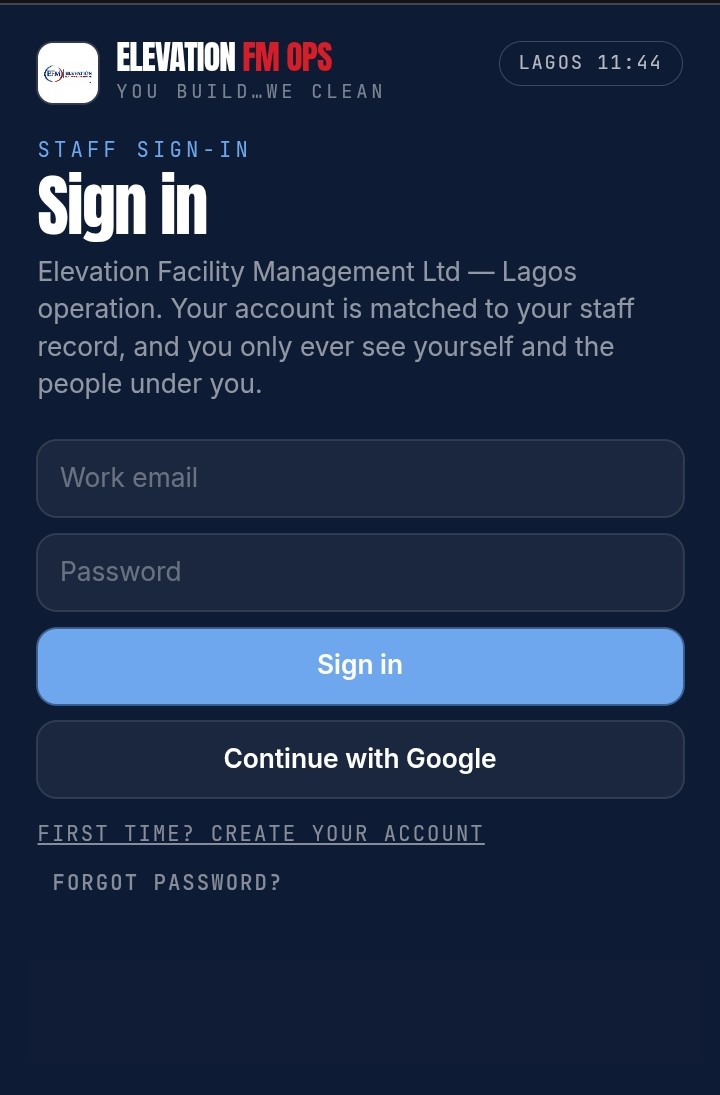
CleanOps — role-scoped sign-in: each person sees their own record and the people under them.
Key system components
Staff & attendance
Staff records, attendance and site check-ins.
Schedules
Shift and job scheduling across multiple client sites.
Clients & sites
Contract sites with their own requirements and history.
Cleaning jobs & daily reports
Work logged and reported at the point of delivery.
Expenses & transportation
Operational costs recorded against the work that caused them.
Leads & sales pipeline
New business tracked alongside delivery capacity.
Complaints & quality control
Issues captured, routed and closed with a record.
Equipment
Assets tracked to sites and staff.
Revenue & performance
Income and activity measured per site and per team.
Weekly insights
A recurring operational summary for the owner.
How this improves visibility and control
Because attendance, jobs, reports, costs and complaints share one record, the owner sees the operation as it happens rather than as it is retold. Remote oversight becomes a matter of reading the system, not chasing people.
Technology used
What this demonstrates
That an operations-heavy business with distributed staff can be made visible and controllable from anywhere — and that the hard part is the operational model, not the code.
Discuss a similar problemCase study 03 · Domestic & Maid Services
Maid Service Operations System
- Client
- Internal operations system for a maid service
- Location
- Nigeria
- Our role
- Designed and led delivery
A staff-facing operations system for a maid service, built around the real bottleneck in that kind of business: getting new cleaners trained, consistent and accountable without the owner repeating herself every week.
The operational challenge
- New staff were onboarded verbally, so standards depended on who trained them and how much they remembered.
- Guidelines, techniques and conduct rules lived in the owner's head and in scattered messages.
- Attendance was confirmed by conversation rather than by record.
- Staff had nowhere to look up “how do I do this job properly?” at the moment they needed the answer.
What was designed and built
- A searchable staff handbook written in plain language, answering questions the way staff would actually ask them.
- Training material organised by job type — quick job, deep clean, technique, conduct, reference.
- A simple daily attendance tick-in designed for phones and low-friction use.
- Staff records and operational guidelines kept in one place instead of across chats.
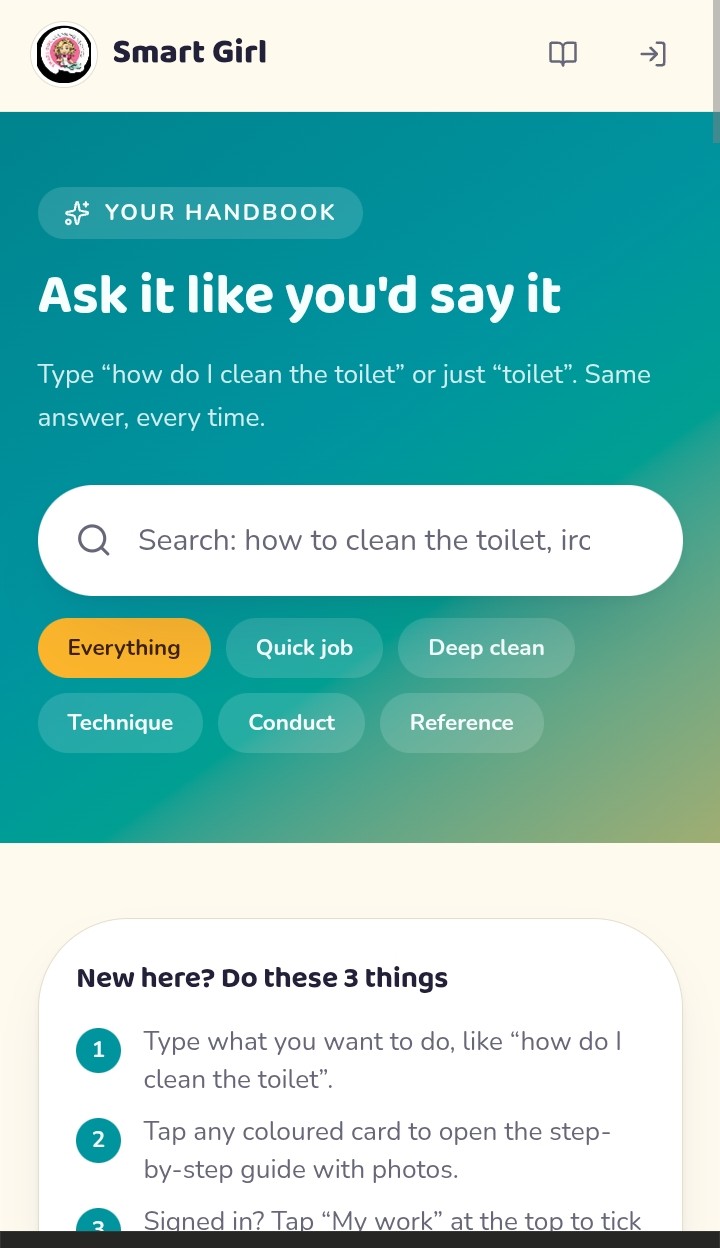
The staff handbook — searched the way staff actually phrase the question.
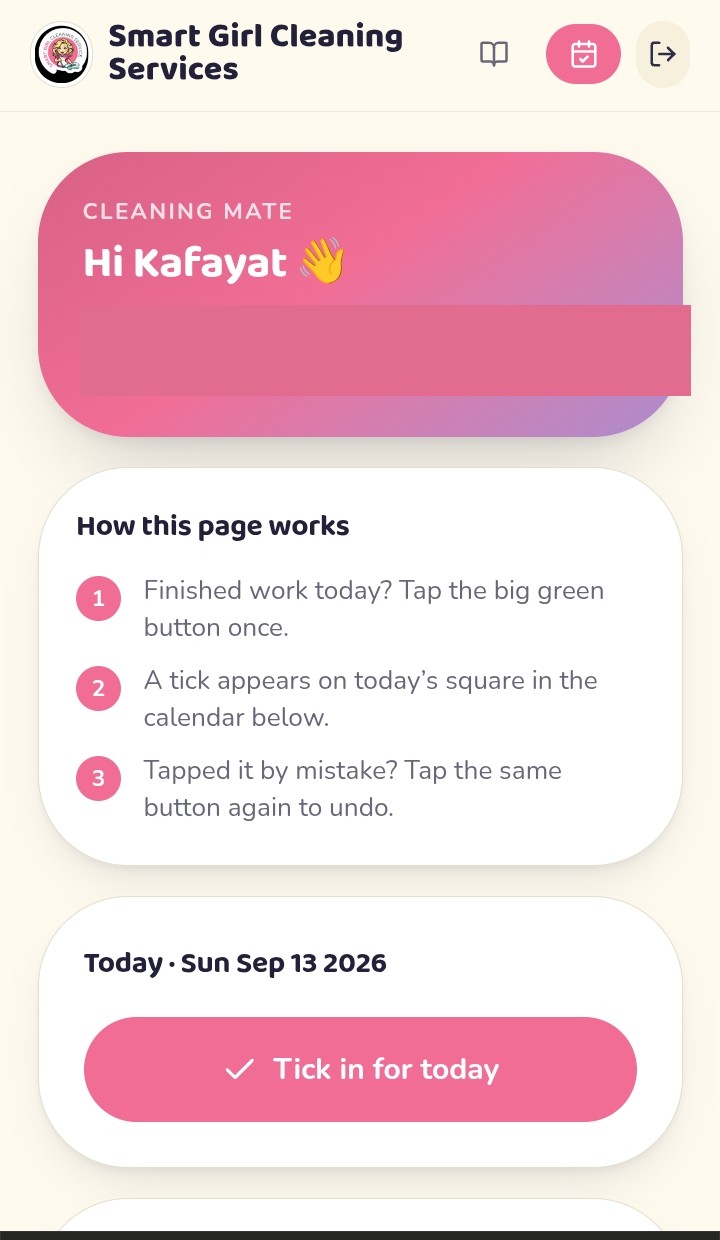
Daily attendance — deliberately one tap, because anything harder does not get done.
Key system components
Onboarding
A defined path from new hire to working staff member.
Staff handbook
Searchable guidance written the way staff ask questions.
Training materials
Step-by-step guides by job type, with photos.
Attendance
One-tap daily tick-in with a visible calendar record.
Staff information
Central records for each team member.
Operational guidelines
Conduct and standards documented once, applied consistently.
How this improves visibility and control
Standards stop depending on who trained whom. The owner can see who worked, and staff can answer their own questions without interrupting anyone — which is what makes a service business repeatable.
Technology used
What this demonstrates
That documentation and training are operational infrastructure. Centralising them is often a bigger lever than any automation.
Discuss a similar problemStill building
More systems in development
Further business systems are currently in design and build. They are not published here yet, because a case study is only worth reading when the system behind it is real and running.
Have a problem that looks like one of these?
A Business Systems Audit is usually where these projects start. It maps how work moves through your business before anything is built. You can also read what we do or the common questions.
Book a Business Systems Audit